
If your company publishes a video in the EU where AI made someone appear to say or do something they didn't, or created realistic footage of people, places or events that never happened, you now have to tell viewers. That duty comes from Article 50 of the EU AI Act and has applied since 2 August 2026. AI used to clean up sound, grade colour or speed up editing doesn't trigger it on its own.
I use AI in post-production almost every day, for translation, sound cleanup and dubbing, and wherever it shows up in a client video we label it. Below is how the rule works in practice for business video: interviews, brand films, event recaps and the AI tools that now sit inside most edits.
What Article 50 actually requires
The AI Act splits transparency duties between two groups.
Providers are the companies that build generative AI tools. They must mark output in a machine-readable way, such as metadata and invisible watermarks. Tools already on the market before August 2026 have a grace period until 2 December 2026, set by the Digital Omnibus amendment (Regulation (EU) 2026/1744, published in the Official Journal on 24 July 2026).
Deployers are everyone who uses those tools in a professional context and publishes the result. That includes your company and your video producer. Under Article 50(4), a deployer who publishes a deepfake must disclose that the content was generated or manipulated by AI.
The Act defines a deepfake as AI-generated or manipulated image, audio or video that resembles existing persons, objects, places or events and would falsely appear authentic. According to an analysis by Paul, Weiss, intent to deceive doesn't matter: the test is whether the content could plausibly pass for real.
Two more points matter for marketing teams:
For clearly artistic, creative, satirical or fictional work, the duty is lighter. You still disclose, but in a way that doesn't spoil the work.
Content published before 2 August 2026 doesn't need to be labelled retroactively.
Fines for breaching the transparency rules can reach €15 million or 3% of worldwide turnover, whichever is higher.
Which AI edits need a label
Here is how I'd sort the AI uses that come up in real corporate projects. Treat this as a practical reading of the rule, not legal advice.
No label needed:
noise reduction, dialogue cleanup, mic bleed removal;
auto-colour, upscaling, stabilisation, reframing to vertical;
AI transcription and translated subtitles, since text on screen isn't presented as the speaker's own voice.
Label it:
voice clone dubbing, where your CEO suddenly speaks Spanish or German in their own voice: a real person appears to say words they never recorded;
lip-sync to a new language;
an AI avatar or digital twin of a real employee;
generated b-roll of realistic offices, cities, crowds or products that could pass as real footage.
Grey area, label to be safe:
a synthetic voice-over that doesn't imitate a real person;
clearly stylised animation or illustration. It usually doesn't look real, so it may fall outside the definition, but a short credit costs nothing.
The pattern is simple. If AI changes what a real person said or did, or invents footage that looks like a real recording, label it. If AI only polishes what the camera and microphones actually captured, you're fine.
My take: AI is a tool, the words stay real
I use AI a lot in post-production: translation, sound cleanup, and dubbing into other languages and avatars with HeyGen for some clients. Every time, the video gets the right label. When a platform has its own AI marking, as Instagram does, I always switch it on.
Generating a speaker's voice is something I do only in exceptional cases. It happened once: a speaker was listing key points from memory, got one of them wrong, and that line had to be fixed in post. It was a one-off, and that video wasn't published for an EU audience.
I'm firmly against AI standing in for a real person to mislead viewers. No client has asked me to push a video that far, and my own ethics wouldn't let me do it.
For me AI is the same kind of tool computer graphics or the internet were in their time. What matters is the person's own statement and their real thoughts. Polishing the sound or cleaning distracting things out of the frame, the way film crews have always done, is healthy and right.
How to label: the Code of Practice
On 10 June 2026 the European Commission published a final Code of Practice on marking and labelling AI-generated content. It is voluntary, but following it is the easiest way to show you've complied.
For deployers, the Code introduces common EU icons for fully AI-generated content and for AI-modified content, plus a basic icon that opens a second layer with details. Where a visual label isn't possible, as with audio-only content or a podcast feed, an audible disclaimer is expected.
On video placement, the Code doesn't set a single rule, but the guidance points in one direction: a notice only at the very start may not be enough when people often join a video halfway, which is how most LinkedIn and Instagram views happen. A practical setup for business video:
a short on-screen note when the AI segment appears, for example "Voice translated with AI";
a line in the video description or post text;
the same note in end credits for longer films.
What an AI label looks like
The EU icons. The Commission has released three official icons: a basic round "AI" mark, "AI GENERATED" for fully synthetic content and "AI MODIFIED" for content that was partly changed. They come in black and white, and anyone can use them for free without attribution. You can download them from the EU icons page. The page also makes clear that using an icon doesn't prove compliance by itself; the label has to be clearly visible at the latest when the viewer first sees the content.
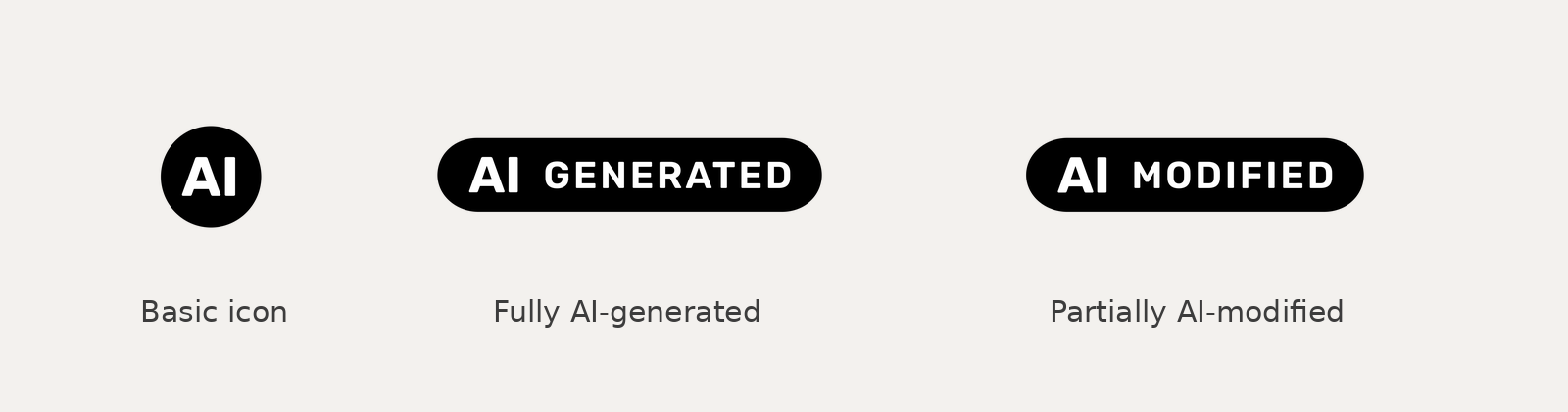
The official EU icons for labelling AI content. Source: European Commission, free to use without attribution.
In the video itself. For a translated interview, a practical layout is the "AI MODIFIED" icon in a corner of the frame plus a short line of text when the dubbed part starts.
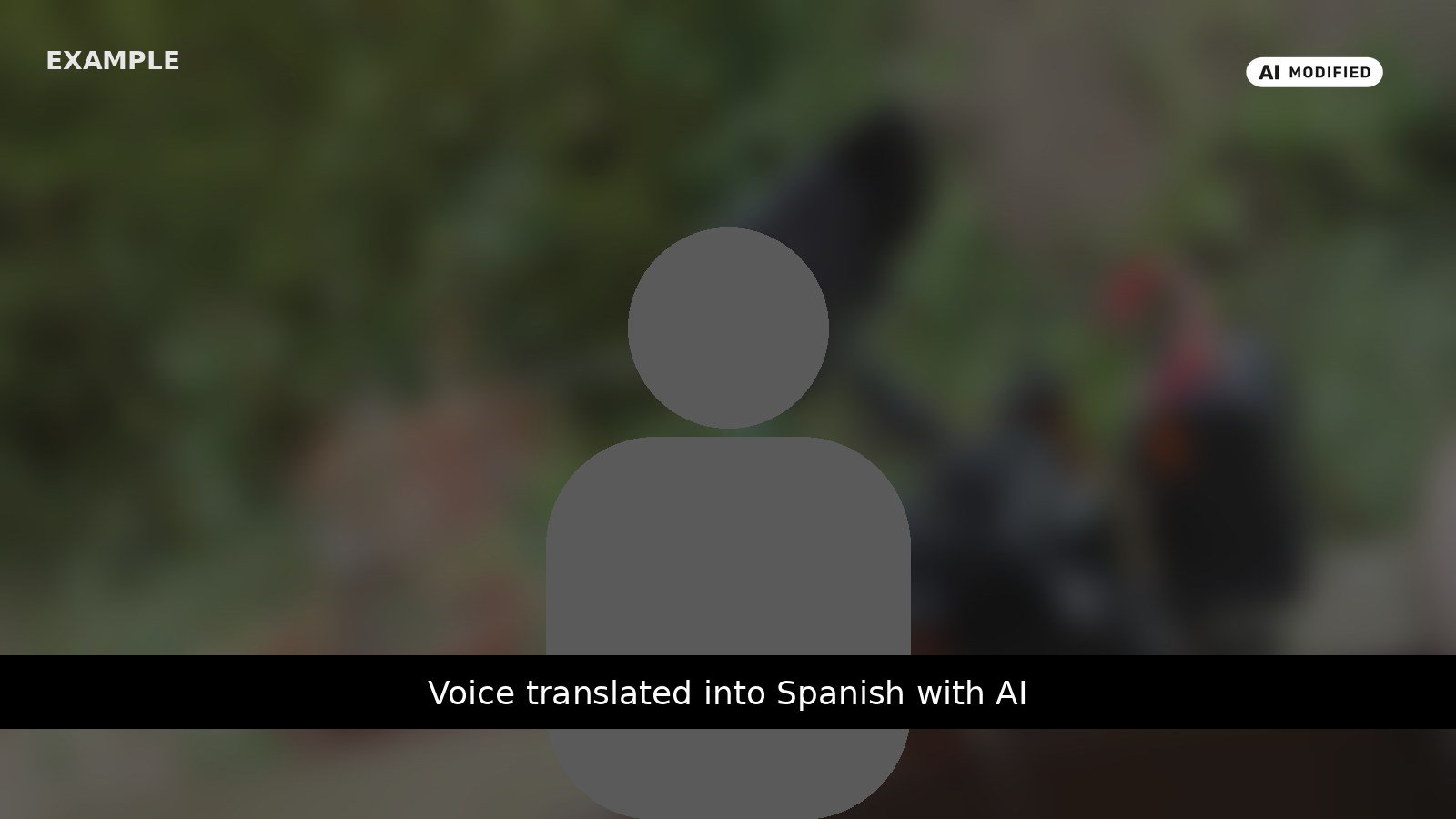
Illustration: how an AI label can look in a translated interview.
On YouTube. When you upload, YouTube Studio asks whether the video contains realistic altered or synthetic content. If you say yes, viewers see a "Made with AI" note in the "How this content was made" section of the description, and for sensitive topics such as news, health or finance the label also appears on the player (YouTube Help). Watch out: YouTube's own rules are narrower than the EU duty. For example, it doesn't ask creators to disclose cloning their own voice for dubs, so the platform label alone may not cover you in the EU.
On Instagram and Facebook. Meta shows an "AI info" label on AI-made posts, and Instagram lets you add the AI label yourself when you publish. Use it, and still put the note in the video, because the platform label disappears once the clip is downloaded or reposted elsewhere.
Keep the original files and a note of which tools you used. If a platform or client asks, you can show what was generated and what was filmed.
What about Spain?
Spain has worked on its own law to apply the AI Act, the Ley Orgánica para el buen uso y la gobernanza de la inteligencia artificial. The Council of Ministers approved the bill on 26 May 2026 and sent it to Congress. It named AESIA, the Spanish AI supervision agency in A Coruña, as the main enforcer and set fines up to €35 million or 7% of turnover for the most serious cases. The draft also suggested that fully AI-generated video should carry a notice for the whole playback, while partly modified video would need one at the start.
As of November 2026 that bill hasn't been passed, and parliamentary trackers list it as lapsed. This doesn't change much for you: Article 50 is an EU regulation and applies directly in Spain without a national law. Watch for a new Spanish bill, since it would decide how AESIA enforces the rule and may add detail on label placement.
A checklist before you publish
List every AI tool used in the edit, from the producer and from your own team.
Mark segments where a real person's voice, face or words were altered or generated.
Mark generated footage that could pass as a real recording.
Add an on-screen note at those segments and a line in the post text.
For podcasts or audio versions, add a spoken disclaimer.
Get written consent from anyone whose face or voice is cloned. That is a separate requirement under GDPR and Spanish image rights law, and labelling doesn't replace it.
Archive original footage and project files.
FAQ
Do I need to label a video if AI only cleaned up the sound?
No. Noise reduction, colour correction and similar edits don't create content that falsely appears authentic, so Article 50(4) doesn't apply.
Who is responsible for the label, the video producer or the client?
Both can be deployers, but the company that publishes the video under its name carries the main duty to the viewer. Agree in the brief who adds the label and where.
Is AI-translated dubbing of our CEO a deepfake?
If a cloned voice or lip-sync makes a real person appear to speak words they never recorded, it most likely fits the definition. A short "AI voice translation" note solves it.
Do the rules apply to videos published before August 2026?
No retroactive labelling is required for content published before 2 August 2026.
Planning a video with AI in the workflow?
I film interviews, podcasts and brand films in Barcelona and handle post-production, including AI translation and subtitles. If you'd like a shoot planned so that the AI parts are labelled correctly from the start, get in touch. See also expert interviews and video podcasts, client testimonial videos and brand films and commercials.