
Yes, you can use drone footage for a business video in Barcelona, but over the city it is never a spontaneous shot. Almost the whole area sits inside controlled airspace around El Prat and Sabadell airports, urban flights need advance notice to the police, and some locations such as the port have their own permit with a 10-day lead time. It's doable with planning, though in my own work I usually take aerial shots outside the city, where the rules leave more room for the shot itself.
Below is what the rules ask for in 2026, what your production team should handle, and what you as the client should check before you book.
Which rules apply to drone filming in Spain
Two layers apply at the same time.
The EU layer is the EASA drone framework (Regulations 2019/947 and 2019/945). It sorts flights into categories by risk. Most commercial filming falls into the open category or, when the flight is more complex, the specific category, which needs a risk assessment or a standard scenario.
The Spanish layer is Royal Decree 517/2024, published in the BOE on 5 June 2024 and in force since 25 June 2024. It replaced most of the old RD 1036/2017 and filled in the national details: minimum ages, insurance, radio requirements and how UAS geographic zones work. According to industry summaries, it also made ENAIRE the single source of information on drone zones and dropped the old 8 km distance rule around airports in favour of the zone map.
The decree also says clearly that it applies without prejudice to privacy and data protection rules and to landowners' rights. So aviation approval alone does not give you the right to film people or to take off from someone else's property.
The open category in plain terms
All open-category flights stay below 120 m, within the pilot's line of sight, and never over gatherings of people. Within that, three subcategories set how close you can get to people who are not part of the shoot:
A1 (drones under 250 g, class C0, and C1 under 900 g): avoid flying over uninvolved people, never over crowds.
A2 (class C2 drones under 4 kg): at least 30 m horizontally from uninvolved people.
A3 (heavier drones, C2 to C4 and legacy under 25 kg): nobody at risk, and 150 m away from residential, commercial, industrial or recreational areas.
Source: AESA, open category subcategories A1, A2 and A3.
The practical consequence for a city: a small sub-250 g drone in A1 is the easiest legal fit for many urban shots, while bigger cinema drones usually need A2 certification or a specific-category operation.
What makes Barcelona harder than the countryside
Controlled airspace almost everywhere
Barcelona lies inside the control zones (CTR) of El Prat and Sabadell, plus several heliports and restricted areas. Before any flight the operator checks the official ENAIRE Drones map for the exact point, and each zone that shows up may need its own coordination. Operators who talk to air traffic units by radio need an AESA radiotelephony certificate (article 34 of RD 517/2024).
Urban flights and the police
Flights over urban areas need prior notice to the Interior authorities. In Catalonia that means the Mossos d'Esquadra; local operators' guides give at least five calendar days of notice. The Port of Barcelona, in its own permit requirements, lists notifications to both the Spanish and the Catalan Ministries of the Interior. In practice, a responsible operator handles both and keeps the receipts.
The Port of Barcelona
If your shoot touches the port, Port Vell or the harbour coastline, there is a separate Port of Barcelona drone filming permit. The application goes in at least 10 days before the shoot, decisions usually take 8 to 10 working days, and no answer means no. The package includes a flight plan, an operational risk assessment, liability insurance, the police notifications and coordination with the port heliport and emergency services. Port fees apply if the permit is granted.
Events and people
You cannot fly over a concentration of people in the open category. For a conference, a product launch or a street event, that rules out the classic shot straight above the crowd unless the operation is set up in the specific category with the right authorisation. Plan aerial shots for the venue exterior, arrivals, the empty space before doors open, or wide shots from a safe distance.
Insurance, registration and paperwork
Operator registration. Anyone flying a drone of 250 g or more, or any drone with a camera that can capture personal data, must register as an operator with AESA and show the number on the aircraft.
Remote ID. Mandatory since 1 January 2024 for class-marked C1, C2 and C3 drones.
Insurance. Under article 8 of RD 517/2024, drones of 20 kg or more always need liability insurance; lighter ones need it for A2, specific and certified operations. Local guides and the Port permit expect insurance on professional jobs anyway, and you should ask for it in writing.
Pilot certificates. A1/A3 is an online AESA exam; A2 adds practical training and a second exam.
How long it really takes
For a simple flight away from restricted zones, a few days can be enough. Over central Barcelona, near the coast or at the port, plan on two to three weeks between booking and flying. Weather adds its own margin, so keep a backup date.
My take: what I've learned flying for clients
I'll be honest about my own approach: I try not to fly in the city at all. Fitting an urban flight into all of the rules above is hard, so most of my aerial work happens outside Barcelona, where the airspace is simpler and the shot can be planned around light and terrain instead of paperwork.
When clients ask for aerial footage, the same few problems come up.
Not every building looks good from above. Most of my drone requests are architecture. Some buildings are designed to be seen from the street, from their courtyard, from a low angle within the surrounding blocks. From above, the same building can look awkward or even ugly. The architect never meant it to be read from the sky. Before we book a flight, I ask the client to think about how the building was meant to be seen, and sometimes the honest answer is a ground-level or low-altitude shot.
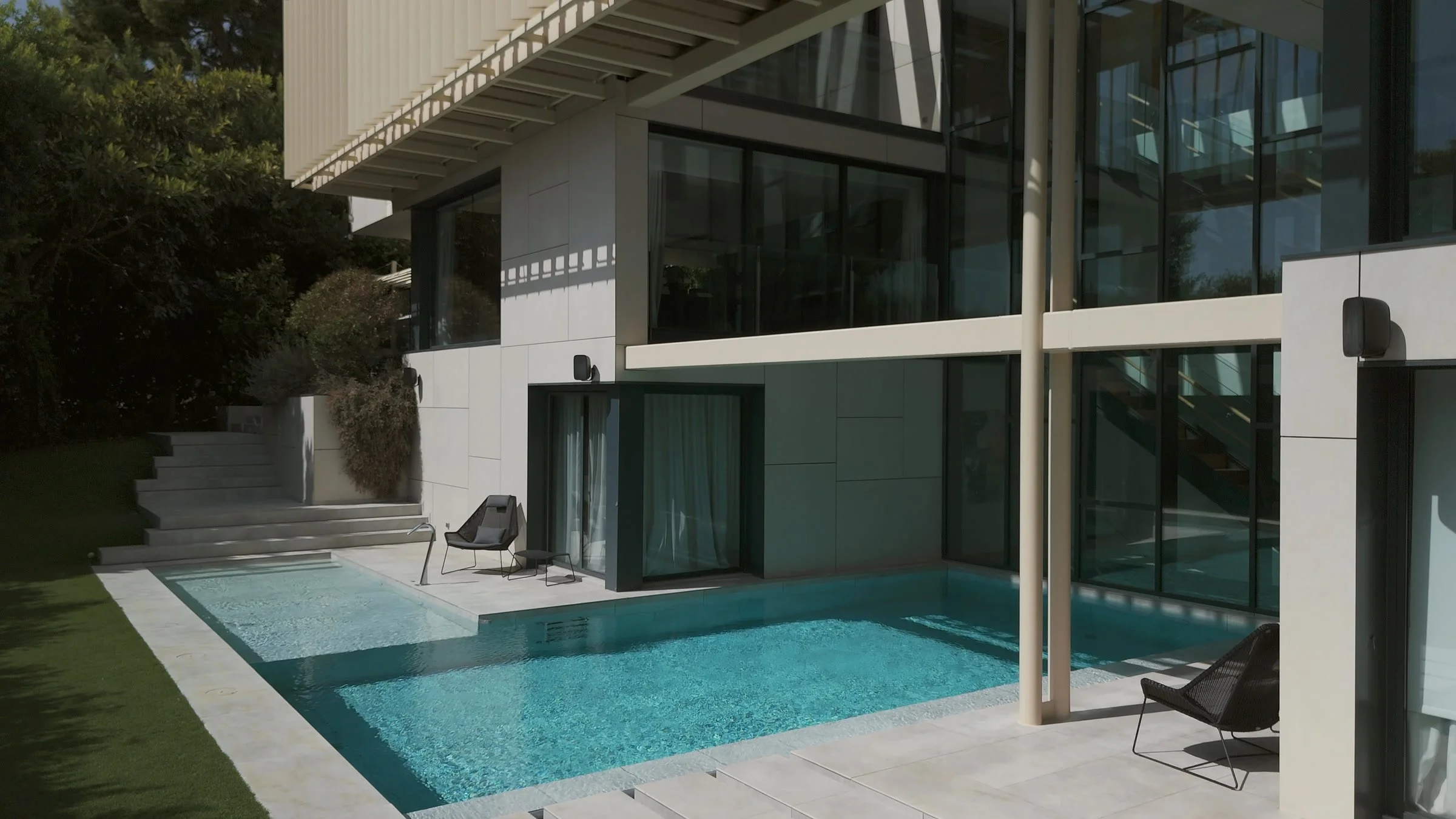
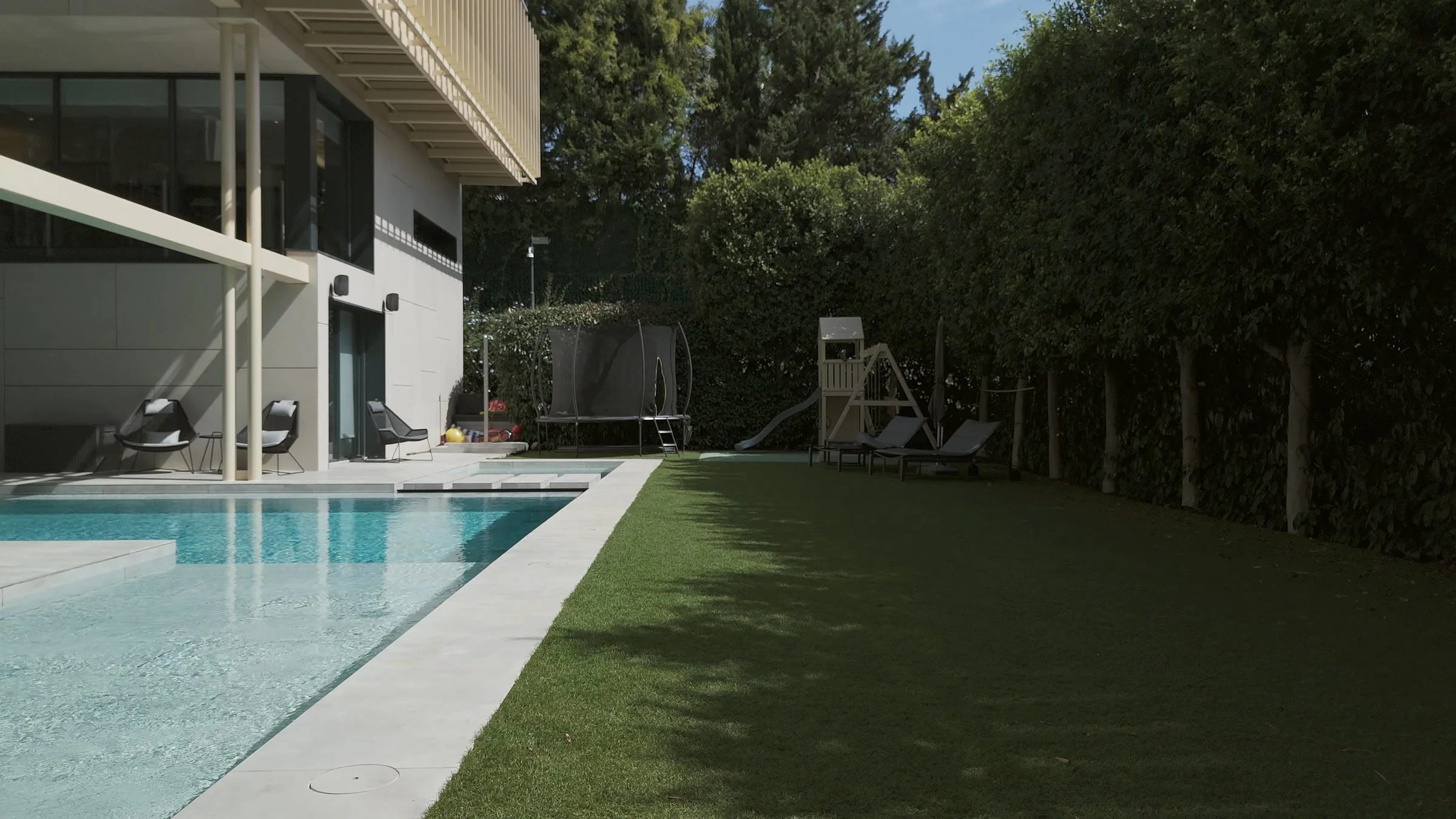
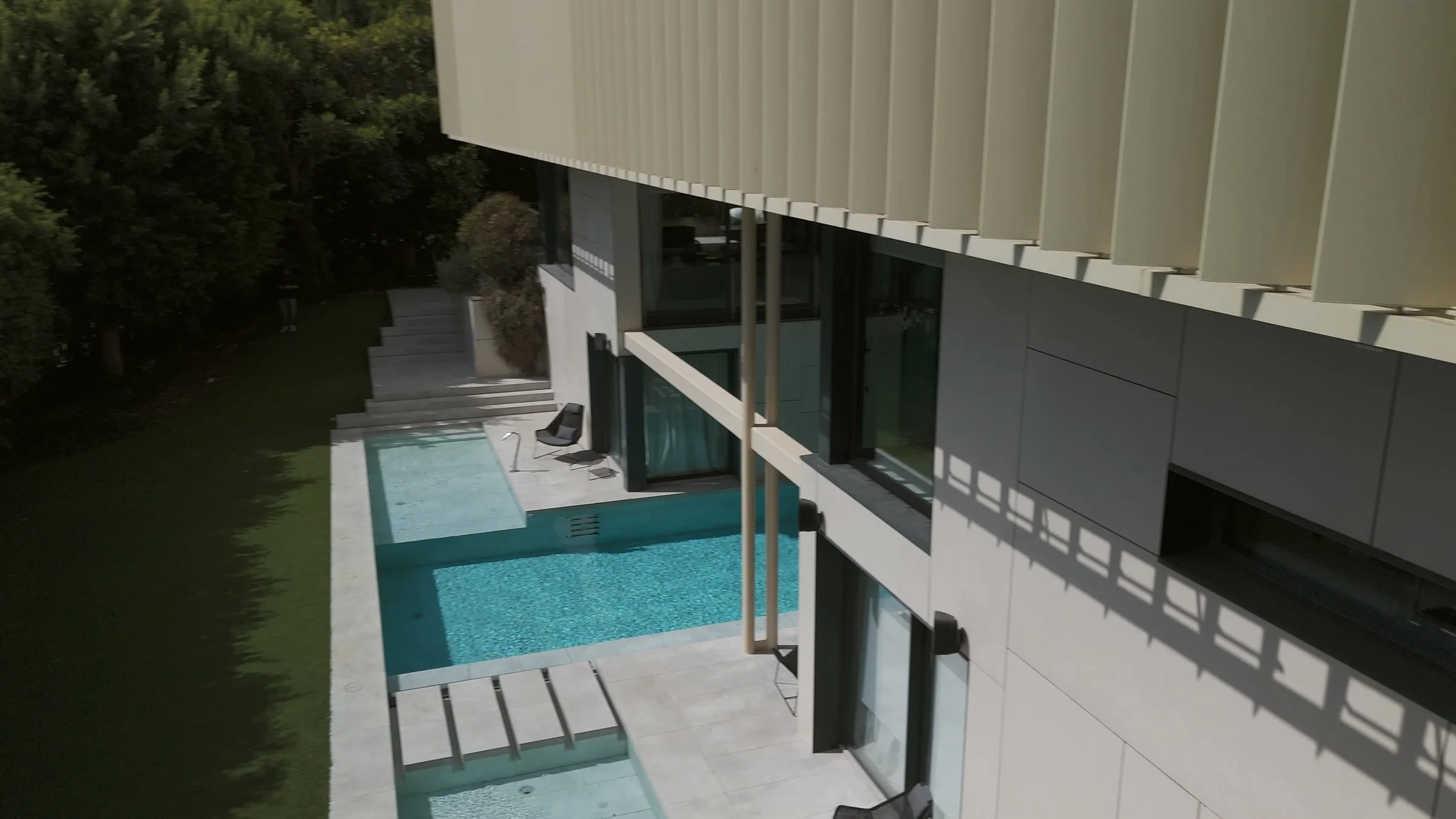
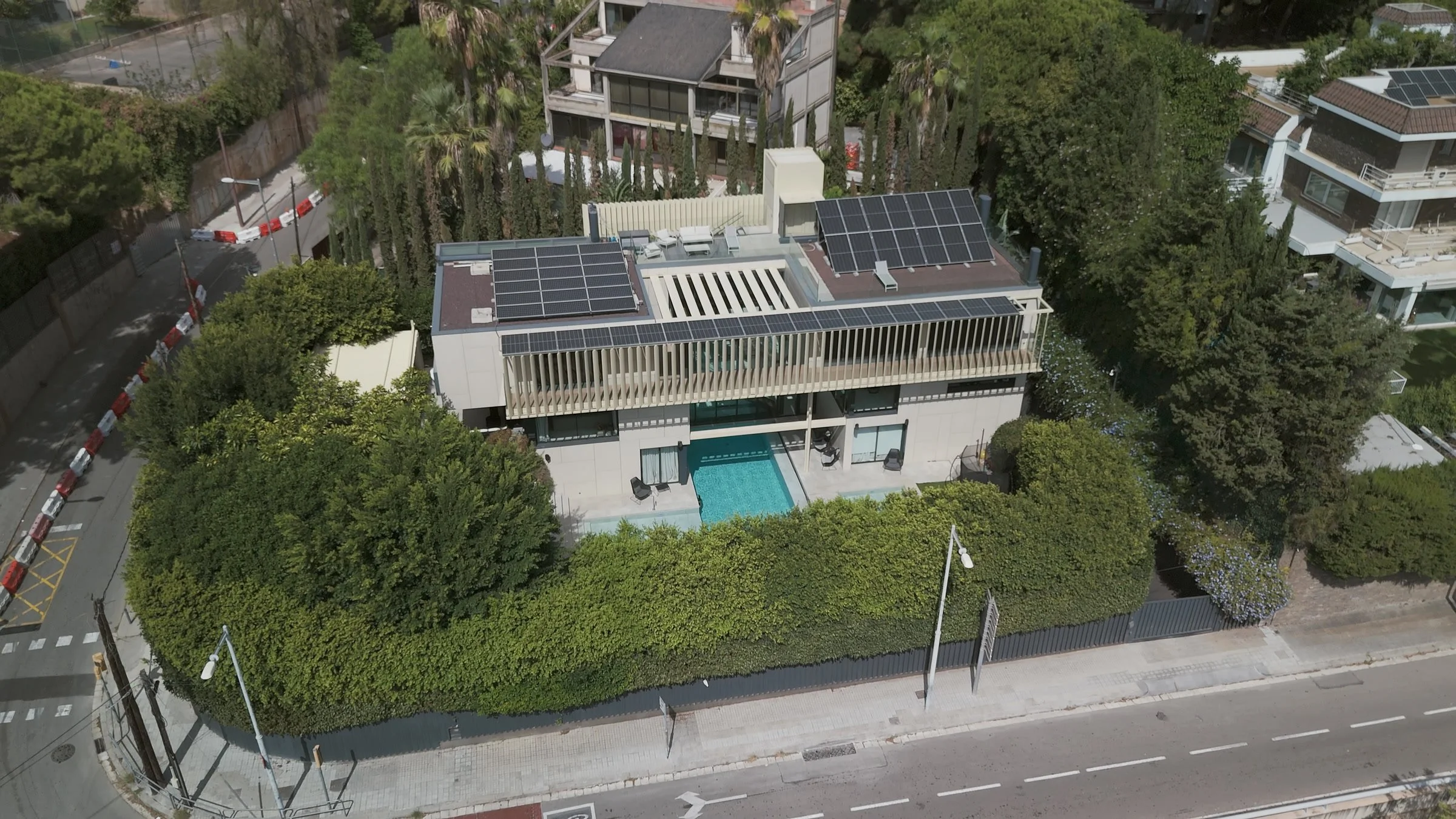
Below: one villa in Barcelona, filmed on the same day. The first three frames are low drone angles that keep the glass, the slatted canopy and the pool the way the architect intended. The last one is from higher up: the facade hides behind the hedge, and the frame fills with solar panels, roof equipment and the road.
Nobody knows where the property ends. For land and estates, the brief is often "film the whole plot". On a site of around 240 hectares, that only works if someone can show me the real boundaries. If the client can't, I end up guessing what belongs to the property and what doesn't. Get a plan or a map with the borders marked before the shoot day.
Bad weather makes everything look poor. In rain or under a flat grey sky, aerial footage looks thin and dull. If the shot matters, plan it for good weather and keep a backup date.
Wind is the risk people underestimate. Once, outside the city, I flew towards a beautiful little tower on a hill about two kilometres away. The wind was behind the drone, and it picked up speed to around 10 m/s, well above what it normally cruises at. On the way back it was fighting a strong headwind, the battery drained fast, and it couldn't make it back to my take-off point. Since then I check the wind at altitude before any long-range shot and plan the return leg with headwind in mind.
What to ask a drone operator before you book
Which category and subcategory will this flight be in, and with which drone?
Have you checked the exact location on the ENAIRE map, and which coordinations does it need?
Who sends the police notification, and when?
Can you send your AESA operator number, pilot certificate and insurance policy?
What is the plan B if the permit or the weather doesn't work out?
For land or estates: do you have a map with the property boundaries marked?
A good operator answers these in one email. If the answers are vague, the risk lands on your shoot day.
FAQ
Do I need a permit to film with a drone in Barcelona?
Usually yes, in the sense of coordination and notifications rather than one single permit. Most of the city is controlled airspace, urban flights need police notice, and the port has its own permit.
Can a drone fly over people at my event?
Not in the open category. Flying over gatherings needs a specific-category operation with prior authorisation, so most event aerials are planned around the crowd.
How far ahead should I book drone filming in Barcelona?
Two to three weeks for central or coastal locations. The Port of Barcelona alone asks for at least 10 days.
Is a sub-250 g drone exempt from the rules?
No. It is easier to fly legally in A1, but airspace zones, police notification, privacy rules and operator registration (if it has a camera) still apply.
Plan your aerial shots with us
We plan and film aerial video in Barcelona and across Catalonia, from property and architecture to brand films and events. See our drone and aerial video service and event video, or get in touch with your location and date and we'll tell you what it takes to fly there.
This article is general information, not legal advice. Rules change; check the current AESA and ENAIRE guidance for your specific operation.