
LinkedIn video for B2B works best when real people from your company talk about real problems, in short vertical clips cut from one longer recording. In my own shoots, conference and industry interviews consistently perform best there. LinkedIn now pushes video harder than any other format, and for most B2B teams it has overtaken YouTube as the main place their video gets seen. Below is what changed, which formats actually get watched, and how to produce them without turning your team into full-time content creators.
What changed on LinkedIn in 2025–2026
A few shifts matter if you sell to other businesses:
A dedicated vertical video feed. LinkedIn added a full-screen, swipeable video feed. Vertical 9:16 clips fill the screen there, and industry guides report they get more distribution than square or horizontal ones.
More people are watching. LinkedIn's marketing team told Business Insider that video views grew about 36% year on year in 2025, and that video creation is growing roughly twice as fast as other post types.
B2B marketers moved their video budget here. In Wistia's 2026 State of Video report, 81% of surveyed businesses named LinkedIn as a primary video channel, ahead of YouTube at 76%. Keep in mind this is what marketers say, not measured performance, and Wistia surveyed its own audience.
Video ads next to premium content. BrandLink, launched in 2025, places your ad before videos from publishers and creators. In March 2026 LinkedIn expanded it with new publishers such as TIME and Reuters Japan, and added Top Voices 360, a way for brands to sponsor shows by well-known LinkedIn creators.
Less patience for generic content. LinkedIn rebuilt its feed ranking in 2026 and added a way to report "AI slop". Stock-footage videos with a voiceover over them are exactly what the platform is trying to show less of.
In a survey LinkedIn commissioned from YouGov in early 2026, 81% of B2B CMOs said video shortens their sales cycle. That is an opinion poll of marketers, so treat it as a signal of where budgets are going, not as proof.
Which LinkedIn video formats work for B2B
Expert clips from your own people
A founder, engineer or partner explaining one specific thing in 30–90 seconds. This is the format that builds trust, because buyers see who they will actually work with. Posts from personal profiles usually reach far more people than company page posts, so plan for the expert to post from their own account and the company page to share it.
Video podcast episodes, cut into clips
A 30–45 minute conversation with a client, partner or colleague gives you one long episode for YouTube or your site and 8–15 short clips for LinkedIn. One recording, a month of posts. This is the most efficient format I film, and the one I recommend most often. See how I set these up on the expert interviews and video podcasts page.
Event and conference clips
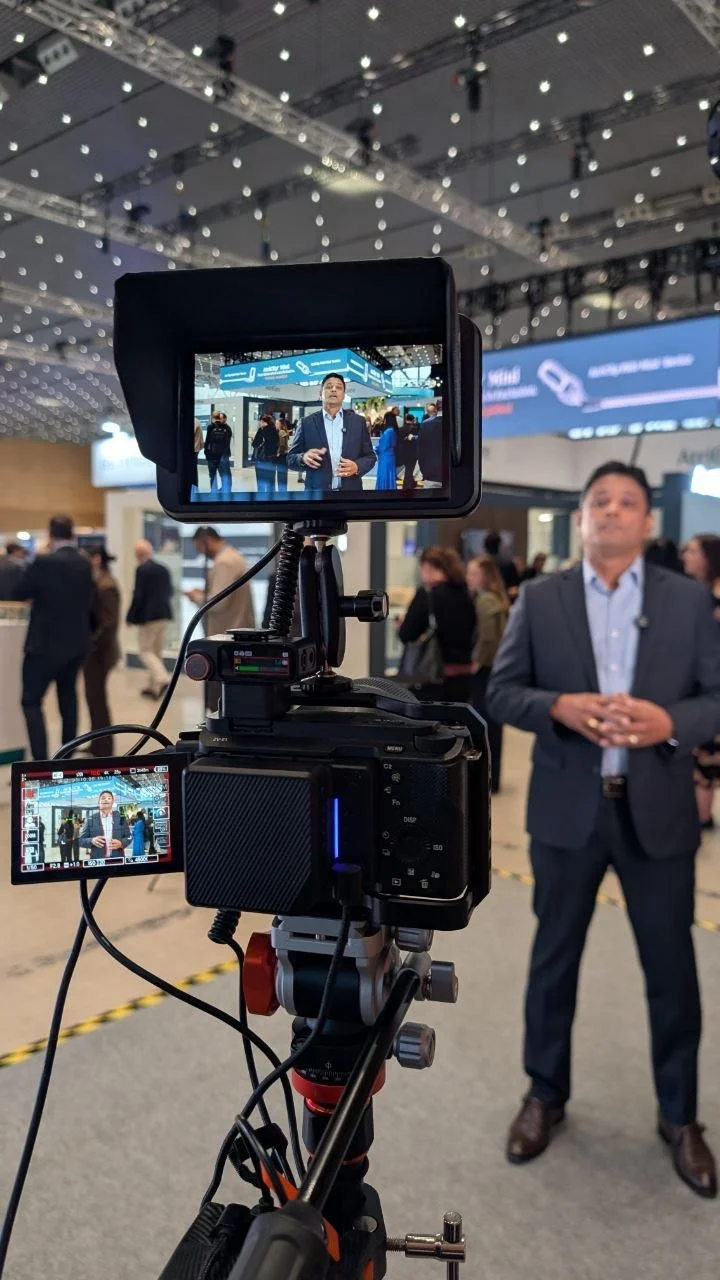
Trade fairs and conferences in Barcelona (MWC, ISE, Smart City Expo) are full of short conversations that make strong LinkedIn content: a 40-second interview at your stand, a quote from a speaker, a fast recap. The key is to plan the clips before the event, not hope they appear in the edit. More on the event video and aftermovies page.
Short brand and recruitment films
A 60–90 second company film still has a place, especially pinned on the company page or used as a BrandLink or video ad. It works as the "who we are" piece behind your expert clips. See brand and company films.
Live sessions
LinkedIn Live suits webinars, product launches and Q&A sessions. It needs a stable connection, decent sound and someone running the stream, and the replay can be cut into clips afterwards.
How to film a month of LinkedIn video in one day
Here is a setup that works for most B2B companies:
Pick 3–4 people who know the subject and can talk about it naturally. They do not need to be "good on camera" yet; a good interviewer fixes most of that.
Write questions, not scripts. Ask about the objections your sales team hears, mistakes clients make, and how things work behind the scenes. Answers to real questions sound like people, scripts sound like ads.
Film in two framings at once. One horizontal frame for the long version and a tighter frame that crops cleanly to 9:16 for LinkedIn. Planning this on set saves a lot of awkward reframing in the edit, and open gate cameras make it much easier (more on that below).
Record clean sound. Viewers forgive average lighting; they leave when they can't hear. Use lavalier or broadcast microphones, not the camera mic.
Burn in captions. Many people scroll LinkedIn with the sound off, so every clip needs readable subtitles.
Start each clip with the point. The first two seconds decide whether someone keeps watching. Open with the claim or the question, never with "Hi, my name is…".
A typical result from one shoot day: 1–2 long episodes, 10–20 vertical clips, and a few still frames for posts.
Common mistakes
Reposting a horizontal brand film as-is. In the vertical feed it shows up as a small strip in the middle of the screen.
Posting only from the company page and expecting reach.
Over-polished scripts read from a teleprompter, which feel like advertising.
Long intros, logo animations and music before anyone says anything.
No plan for who posts what and when, so the clips sit in a folder.
Publishing event clips a week later, when everyone has already moved on.
My take: what works on LinkedIn in my shoots
In my experience, the videos that do best on LinkedIn come from conferences and industry events: interviews with speakers, opinions from attendees, partners, clients and even competitors. Anything about networking and business. People on LinkedIn want to see who was in the room and what they think.
Picture quality matters more here than on Instagram or TikTok. A standard phone-style Reel doesn't stand out in a professional feed. I aim for a rich, cinematic image with real depth, so attention goes exactly where it should: to the stand, the speaker or the guest.
The most common mistake I see is arriving at an event without a plan. Nobody knows who will be filmed, which questions will be asked, or how the footage will later be cut into separate interviews, highlights and short clips. Planning and preparation decide the result more than any camera.
Then there is speed. LinkedIn is a social network, and event content works like news: it's worth most while people are still talking about the event. That's why I recommend paying for a same-day edit, so the first clips go out the same evening. It adds a bit to the editing budget, so plan for it from the start.
Finally, format. Video closer to 4:5 tends to work well on LinkedIn. Newer cameras that record open gate, such as the Sony FX5, use the full height of the sensor, so you can film a horizontal frame and later crop clean 4:5 or 9:16 versions without losing quality. When a project calls for it, I rent one and include the rental in the estimate. It's an extra cost, but it pays off: one shoot gives you both horizontal and vertical content.
FAQ
How long should a LinkedIn video be for B2B?
For organic posts, 30–90 seconds is a safe range for a single point. Longer formats work as podcast episodes or Live sessions. LinkedIn allows uploads up to 10 minutes from the mobile app and longer from desktop.
Vertical or horizontal video on LinkedIn?
For the feed and the video tab, vertical 9:16 or 4:5 takes more of the screen and is what the platform currently favours. Keep a horizontal master for YouTube and your website.
Should our CEO post videos, or the company page?
Both, but personal profiles usually get much more reach. The usual setup: the person posts, the company page reshares.
Do LinkedIn video ads make sense for a small B2B company?
They can, if you already have good organic clips to promote. Test your best-performing organic video as an ad before producing anything ad-specific.
Want LinkedIn video for your team?
I film expert clips, video podcasts and event content for companies in Barcelona and across Catalunya, and deliver them already cut for LinkedIn. Get in touch and tell me who you want to reach.